Salvation Jane is an annual winter weed of pastures. It is considered a resource for apiarists, but is toxic to most grazing animals posing a particular threat to horses.
Description
Also known as Paterson’s curse, salvation Jane is an annual herb that grows from a sturdy taproot that makes them resistant to drought.
Plants can germinate at any time of the year when conditions are favourable however they typically appear in autumn and winter. The dark to light green leaves which form a rosette, are covered in short stiff hairs, broad oval shaped, growing up to 30 cm long and have distinct, branched veins.
Flowering stems are produced in late winter from the centre of the rosette. The erect stems, branching as they mature, are also hairy and normally reach a height of 60 cm. The stem leaves are smaller and narrower than the rosette leaves.
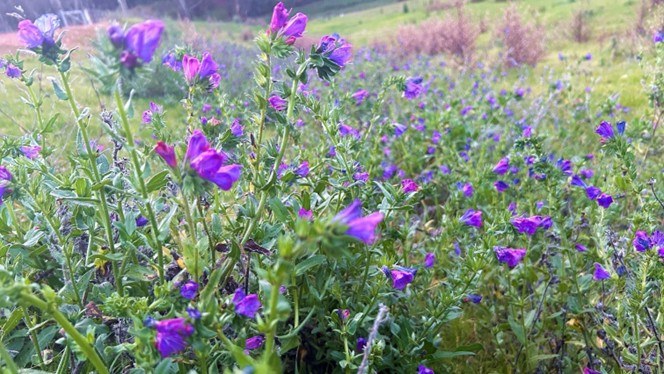
The stems develop flowers from September to December. The flowers are trumpet-like and mostly purple, but
occasionally white, blue and pink. Plants normally die in summer after flowering.
Each flower produces four seeds, which are brown-grey, up to 3mm long, 3-sided and wrinkled. Individual plants can produce more than 5000 seeds per year, which accumulates in the soil to form a large seedbank. Seeds may remain dormant in the soil for up to 5 years.
Impacts
Salvation Jane is a significant pasture weed. The plant’s early winter growth allows it to out-compete pasture seedlings. The large, flat rosettes smother desirable plants becoming the dominant species in pastures.
The plant produces poisonous alkaloids that affect livestock, particularly horses and pigs. After feeding on salvation Jane for extended periods the plant causes irreversible liver damage, with animals losing condition resulting in serious health issues.
Salvation Jane can contribute to soil erosion by suppressing perennial grasses in spring. When it dies off in summer, bare soil is exposed to potentially erode.
Salvation Jane can trigger hay fever and allergies in humans. The hairy leaves and stems can cause skin irritation.
Salvation Jane can impact on native vegetation, particularly in disturbed areas where it suppresses the growth and recovery of native species.
Distribution
Salvation Jane was introduced to Australia from Europe as an ornamental garden plant. It is now present throughout the Mount Lofty Ranges region and grows on a wide range of soils. In Green Adelaide it is still found in degraded pastures, disturbed sites and roadsides.
Salvation Jane reproduces by seed. It is commonly spread via contaminated hay and grain, livestock manure and machinery. Birds also spread seed. Cultivation appears to stimulate germination.
Management
Echium plantageinuem (salvation Jane) is a declared weed under the Landscape South Australia Act 2019
To prevent the spread in Green Adelaide, the sale of salvation Jane or contaminated goods is prohibited and the movement of either on a public road is restricted. Land owners must take reasonable steps to control plants on their property and prevent their spread.
We encourage control of plants where there is a risk to human health, agriculture, and biodiversity. Undertaking weed control needs to be done carefully to prevent damage to native vegetation.
Control methods
Biocontrol
There are several biocontrol agents that attack various parts of the plant. These were released during the late 1980s and 90s to help with the control of salvation Jane which had quickly became a widespread dominant pasture weed of temperate Australia.
Alone, biocontrol will not eradicate the weed but it can help reduce the rate of spread and may assist in the management of large or inaccessible infestations. It should not to be relied on to control small infestations.
For advice on chemical options go to PIRSA's Identifying declared weeds.
Competitive cropping
Improve groundcover by introducing competitive crops or perennial pastures to suppress seedling establishment.
Mechanical
Repeated mowing can delay and suppress flowering reducing seed production.
Grubbing or digging out of plants is effective for small isolated populations and can be done any time of the year. If no seed heads are present, you can leave them onsite to decompose.
Spray grazing
Grazing by sheep after spraying paddocks with a reduced rate of suitable herbicide (that sweetens the plant making it more palatable) and before flowering can reduce the weed density and allow pastures to recover. Seek advice from an agronomist for more information.
Chemical
There are a range of selective and non-selective herbicides (weedkillers) on the market. Individual plants can be spot sprayed. Avoid spraying desirable plants.
Boom spraying is most effective on larger infestations in paddocks. Best to treat at the early rosette stage of growth or when plants are actively growing.
Observations of weeds can be entered into iNaturalist, an app which can assist with identification of species.