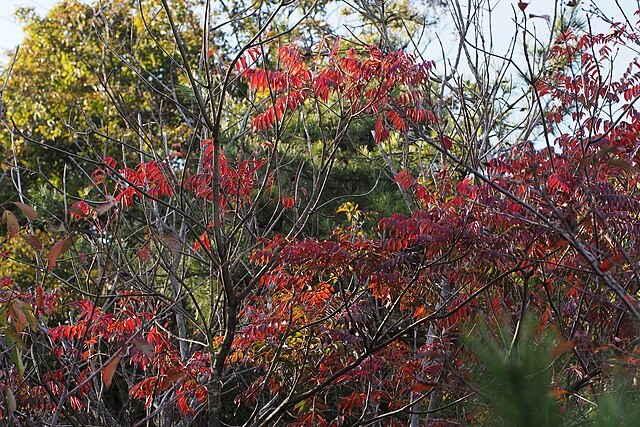
Rhus tree is a small deciduous tree that was once cultivated for garden landscaping because of its magnificent red coloured leaves in autumn. All parts of the plant are toxic to people and may result in severe dermatitis.
Description
A rhus tree (Toxicodendron succedaneum) A large shrub or small tree of 5–8 metres tall with smooth, grey bark.
The leaves are divided into 9–15 leaflets (mostly 11) that are 4–10 centimetres long and 2–3 cm wide. They are arranged in opposite pairs with a single terminal leaflet. These leaves are initially green on top with a greyish underside that turn bright red or crimson before they are shed in autumn.
Flowers develop over spring and summer, are small, creamy-white to yellowish-green in colour and 5–6 mm wide. They form in large clusters 8–15cm long near the tips of the branches.
The papery, rounded fruit are 5–11 mm across and turn pale brown to black in colour as they ripen. Each fruit contains a single 3–5 mm hard, dark brown seed.
This species reproduces by seeds with many germinating near the parent tree.
Impacts
The rhus tree contains urushiol, a toxin that causes severe skin reactions, including painful rashes, itching, localised swelling, and chronic dermatitis upon repeated contact. Symptoms can occur from touching the plant or sap, and inhaling smoke from burning plant material.
Distribution
The rhus tree is native to Japan, China, and northern India.
The rhus tree is still grown in some old established gardens, mainly in suburban Adelaide and the Adelaide Hills.
Dispersal is mostly aided by birds that eat the fruit and deposit the intact seeds elsewhere.
Spread may occur occasionally through the illegal sale of plants at markets, and by seeds that are contained in dumped garden waste or contaminated soil.
Nearly all seeds germinate within a few weeks of autumn rains, with up to 20% of seed set being carried over to the next season. Seeds can remain viable in the soil for 2 years or more.
Management
Rhus tree is a declared weed under the Landscape South Australia Act 2019. The sale of rhus tree or contaminated goods; and its movement on a public road are prohibited.
We encourage control of plants where there is a risk to human health, agriculture, and biodiversity. Undertaking weed control needs to be done carefully to prevent damage to native vegetation.
Control methods
It is best to get a professional tree surgeon to remove rhus tree. If this is not possible, please note that when removing or treating this tree with a chemical it is important to completely cover up your body with gloves, goggles, hat and protective clothing, as every part of the tree is poisonous.
Removal
This is best done during winter when no leaves are present and sap flow is at its lowest.
Dig out the entire plant and roots to prevent reshooting. Put all off-cuts into strong garbage bags and dispose to landfill.
As the toxic resin remains active in the plant material for several months after removal, do not chip, mulch or burn the plant.
Chemical
Cut trunks or stems, and to prevent reshooting apply herbicide to the stump within 15 seconds using a spray pack or brush.
Stem injection can be done during spring and summer when plants are actively growing and not stressed. Drill holes or make cuts into the sapwood and fill with herbicide within 15 seconds. Leave the tree in place to die. Dispose of dead plant material carefully as above as it is still toxic.
Dispose of any used brushes. Clean drills or cutting tools after use to remove sap as the oily resin can remain toxic for several months, even after weathering. Dispose of cut material to landfill.
For advice on chemical options go to PIRSA's Identifying declared weeds.
Monitor
Regularly check controlled sites for several years for any new germinations or regrowth and control immediately.
Observations of weeds can be entered into iNaturalist, an app which can assist with identification of species.