Prickly pears are succulent perennials (long lived) well adapted to survive in areas of low rainfall. Infestations threaten native vegetation, waterways and agriculture. Spines can cause injuries to people and animals.
Description
Prickly pears, a common name used to describe over ten Opuntia species, are perennial succulent plants, long-lived and well-adapted to semi-arid climates with an annual rainfall of 150 mm and grow in all soil types.
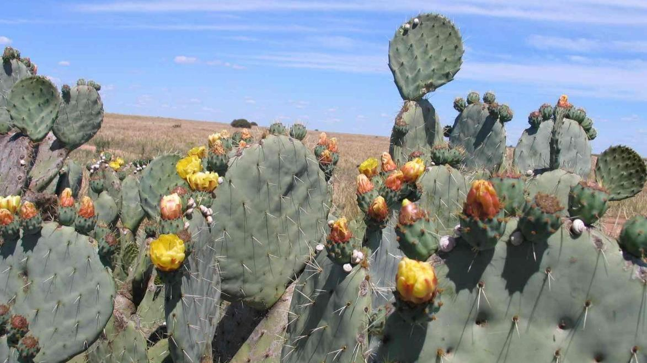
Opuntia species vary in form ranging from sprawling shrubs to large tree like structures up to 6 m in height. They all have flattened cladodes (stem/pad) usually round or oval shaped dotted with large spines. Colours are various shades of green.
Another feature of all Opuntia species are the small hair-like detachable barbed bristles (glochids), which grow from areoles, small pits on the surface of cladodes. Aeroles are also the points where flowers, new shoots or spines grow from.
Flowering typically occurs from late spring to summer with fruits forming in late summer through to early autumn. The large flowers are single, stalkless and cup-like varying in colour from lemon to red to purple.
Opuntia species have large fleshy egg or barrel shaped fruit which range in colour from purple or red to yellow. Not all Opuntia species produce seed and viable seeds can remain dormant in the soil for up to 20 years. Seeds are coated in a hard, pale sheath called an aril.
For a more comprehensive guide to identifying species refer to Managing Opuntioid Cacti in Australia (PIRSA).
Similar species
Indian fid (Opuntia ficus-indica) is a mostly spineless hybrid cultivar grown for fruit production. Although it is not a declared pest plant it can become invasive. Plants grow into a large shrub/small tree to 5 m tall usually with a trunk.
The cladodes are oval to oblong shaped, dull blue-green, 20–60 cm long. Flowers are yellow, and the barrel-shaped fruit to 10 cm long can be, yellow, orange, red or purple. Indian fig reproduces both vegetatively and by seed.
Impacts
Opuntia species impact on agriculture where it is costly to control and stock are injured. Spines can also contaminate wool and cause damage to hides. Plants are quick to spread across idle land of abandoned farms.
In areas of native vegetation and along river banks, infestations can displace desirable plant species. No matter where they grow, Opuntia species are a hazard to both native and domestic animals and to people.
The fruit of Opuntia species is a host for fruit fly, affecting agriculture and suburban food production.
Distribution
Opuntia species originate from the Americas. The most prominent weedy species in Green Adelaide is the common prickly pear (Opuntia stricta) although wheel cactus (Opuntia robusta) and drooping prickly pear (Opuntia monacantha) are also regularly seen. Many Opuntia species have invaded roadsides, idle farmland and riverbanks.
Opuntia species prefer well-draining soil, dry conditions and lots of sunlight to thrive and do poorly in higher rainfall regions as they are prone to rot.
Movement of cladodes is the most common way new plants establish. A single segment is able to take root on contact with soil. Spread is aided when spiny stem fragments become attached to animals, clothing, in particular footwear, machinery and vehicles and then moved. Animals eating the seeds, and water movement also aids in the spread of the weed.
Management
With the exception of Opuntia ficus-indica (Indian fig), Opuntia species are declared weeds under the Landscape South Australia Act 2019 and are a Weed of National Significance.
To prevent the spread in the Green Adelaideregion , the sale of Opuntia species or contaminated goods is prohibited and the movement of either on a public road is restricted. Land owners must take reasonable steps to control plants on their property and prevent their spread.
We encourage control of plants where there is a risk to human health, agriculture, and biodiversity. Undertaking weed control needs to be done carefully to prevent damage to native vegetation.
Control methods
Hygiene
Thoroughly clean clothing and footwear, equipment and vehicles from segments or soil that may contain seed before you leave an infested area.
Dispose appropriately of any excess fruit of Indian fig to avoid fruit fly and limit movement.
Mechanical
Ideal for paddocks and degraded sites and where on-site burial may be an option, mechanical removal can be done at any time. Method may not be suitable in sites where there is risk of soil erosion and damage to native vegetation. Restore soil after disturbance and monitor area for regrowth and seedlings. Treat as required.
Biological
Various species of a cochineal mealy bug, Dactylopius spp., can be effective in controlling large infestations of common prickly pear, drooping prickly pear, and rope pear. Cochineal slowly eats away at the plant, reducing the size of infestations.
Chemical
When using herbicides, plants should be actively growing and not under stress from heat, drought or cold conditions and care must be taken to ensure all parts of the plant are treated for control to be effective. Adding a marker dye will assist with identifying missed plants or cladodes when foliar spraying.
Opuntia species respond well to stem injection which can be used all year round and is an ideal treatment in areas with good native vegetation as it reduces the risk of off-target damage. Applying herbicide to cut stems is another option to reduce off target damage and suitable for isolated plants.
For advice on chemical options go to PIRSA's Identifying declared weeds.
Observations of weeds can be entered into iNaturalist, an app which can assist with identification of species.