Madeira vine grows vigorously to smother and outcompete desired plants in gardens and native vegetation of the Adelaide area. The dense, heavy foliage can damage structures such as fences and sheds and create hazards around the home.
Description
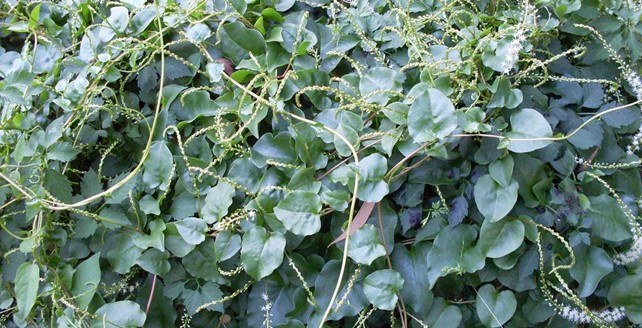
Madeira vine is a long-lived vigorous climber with twinning soft new growth that age to woody stems. In the Adelaide area, it may be semi-deciduous growing 20 to 30 m into trees and over vegetation. Madeira vine has potato-like underground tubers up to 1 m deep in the soil which remain viable for several years, and warty aerial bulbils forming where the leaf meets the stem.
Leaves are heart-shaped, fleshy and waxy, mid green in colour with a wavy margin. The small white star-shaped flowers are fragrant and cluster to form a cylindrical weeping inflorescence up to 65 cm long. Madeira vine flowers from late summer to early autumn. Plants do not produce seed in in the temperate climate of the Adelaide area.
Other common names for Madeira vine are lamb’s tail, jalap and mignonette vine.
Similar species
Climbing lignum or native sarsaparilla (Meuhlenbeckia adpressa) may be mistaken for Madeira vine as it has slightly fleshy leaves occasionally heart-shaped but usually oblong, is twinning with woody mature stems but stems are red-brown and green-yellow flowers form on a short rigid stem.
Impacts
Madeira vine outcompetes and smothers desirable plant species in native vegetation, unoccupied lands and gardens across the Adelaide area, affecting native fauna and flora. Its dense, heavy foliage, not only shades and smothers desired plants but can also damage structures such as fences and sheds. Home safety may also be compromised.
Madeira vine is very difficult to control, is suspected to be toxic to cattle and infestations can destabilise the banks of rivers.
Distribution
Madeira vine is native to the drier areas of South America and occurs in gardens across Adelaide and as a garden escape in native vegetation areas, particularly along moist shaded gullies and streams.
In the temperate climate of Adelaide, plants reproduce vegetatively by underground tubers and aerial bulbils or from severed stems and leaves. Aerial bulbils break off readily and shoot when they touch the soil.
Spread of Madeira vine occurs from the movement of tubers and plant material by water and contaminated goods. But mainly spreads from illegal dumping of garden waste.
Management
Madeira vine (Anredera cordifolia) is a declared weed under the Landscape South Australia Act 2019 and is a Weed of National Significance.
In the Green Adelaide region, the movement of Madeira vine on public roads and the sale of plants or contaminated goods is prohibited.
We encourage control of plants where there is a risk to human health, agriculture, and biodiversity. Undertaking weed control needs to be done carefully to prevent damage to native vegetation.
Control methods
Madeira vine responds to disturbance with vigorous growth so monitor for regrowth after any control is applied and re-treat where necessary.
Hygiene
To prevent the spread of Madeira vine, clean machinery leaving an infested area.
Manual
Vine stems can be cut at ground level and tubers grubbed out using a shovel or trowel at any time of the year. Take care to restore disturbed soil as any resulting soil disturbance can encourage other weeds.
Cut plant material can be composted on site. Ensure all plant material and tubers are collected and placed on a tarp as tubers, leaves and stems can regrow if in contact with soil or exposed to sunlight. Cover with thick black plastic, or place material in large heavy duty garbage bags, then leave to solarise in the sun. Once dead, material can be placed in green waste bin.
Small amounts of recently cut material or dropped tubers can be placed in thick, heavy duty garbage bags, double bagged and securely sealed then placed in a household waste bin.
Chemical
An herbicide for woody plants can be used to treat cut stumps at any time of the year. Cut stems close to the ground and apply herbicide to the cut stem within 15 seconds with a dabber bottle applicator. Herbicide can also be applied by using a low pressurised spray pack.
Spot spray can be used on young plants or ground trailing plants. Applying in warmer months will give better results. Take care to avoid desirable plants.
For advice on chemical options go to PIRSA's Identifying declared weeds.
Observations of weeds can be entered into iNaturalist, an app which can assist with identification of species.