Innocent weed is an annual summer growing grass which produces spiny barbed burrs that can cause injury to people and impacts animals, horticulture agricultural and enterprises, as well as recreation areas.
Description
Innocent weed (Cenchrus longispinus and Cenchrus spinifex), also known as burr grass, sand burr, hedgehog grass and mat sand burr, is an upright standing, fast-growing short-lived summer grass growing up to 70 cm tall. Roots are fibrous and generally shallow, although they can be over 30 cm deep in some soil types. Roots can form where stem nodes (where the stem connects to a leaf) contact the soil.
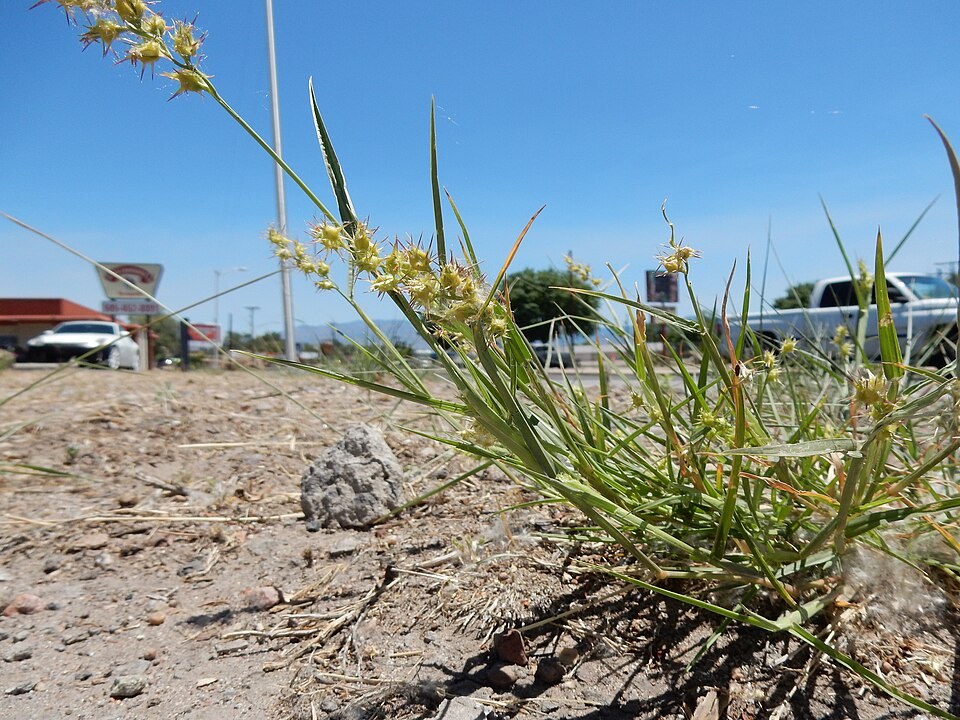
Stems branch from the base of the plant and are soft, smooth, and hairless, flattened with fine serrated edges, often with a slight twist.
Flower heads are produced from October to January with seeds developing from December to April. Seed capsules are oval-shaped and straw-coloured and when mature are covered in long sharp barbed purplish-coloured spines (so-called burrs). Burrs cluster at the top of the stem which are easily detached.
Individual plants produce up to 1000 seeds which can remain viable in the capsule for 5 years and dormant in the soil for up to 3 years. Seeds can germinate from a depth of 20 cm beneath the soil surface.
Most plants die in autumn or winter with new plants germinating from late winter to early summer. Mild weather can promote continued germination and plant survival.
Impacts
Innocent weed has a significant negative impact on the agriculture industry, native vegetation, recreational areas and animals and people
Infestations on agricultural land, in pastures and irrigated horticulture crops reduce productivity and reduce the value of produce including wool, hides and fodder.
Burrs may cause injury to workers when harvesting fruit and also the gut and mouth of stock causing mouth ulcers. Foot injuries to farm dogs may prevent them from working.
Where plants infest recreational and amenity areas, people and pets are at risk of being hurt as burrs readily attach to feet and skin.
Distribution
Native throughout parts of North, Central and South America, innocent weed is widespread across South Australia but has a limited distribution in the Green Adelaide region.
Innocent weed establishes in low fertility dry sandy soils, prefers disturbed areas with summer moisture and minimal competition from established plants.
Seed is spread by burrs attaching to animals, vehicles and machinery, equipment and clothing or from the movement of water, contaminated soil, produce and animals.
Management
Innocent weed (Cenchrus longispinus) and (Cenchrus spinifexis) are declared weeds under the Landscape South Australia Act 2019.
To prevent spread in the Green Adelaide region, the sale of innocent weed or contaminated goods is prohibited and movement via a public road is restricted. Land owners must take reasonable steps to control plants on their property and prevent their spread.
We encourage control of plants where there is a risk to human health, agriculture, and biodiversity. Undertaking weed control needs to be done carefully to prevent damage to native vegetation.
Control methods
Hygiene
The best control measure to prevent spread of innocent weed is to implement good hygiene practices to reduce the risk of movement by contaminated soil, vehicles and machinery, produce, and stock from infested areas.
Brush off clothing and pets before moving away from an infested area. Clean down vehicles and farm machinery using a pressure cleaner, air compressor or brush.
Ecological
Innocent weed does not tolerate competition from dense pasture or vegetation. By maintaining good ground cover, innocent weed can be prevented from establishing.
Mechanical
Grubbing or digging out plants is effective for managing small isolated populations and in sensitive native vegetation areas.
Removed plant material should be double bagged and securely sealed. The bags can be placed in household rubbish bins.
Minimise soil disturbance to avoid stimulating germination of innocent weed seeds that may be left in the soil. Covering the sites with a thick layer of mulch may also help supress seed from germinating.
Monitor sites and destroy any new plants before seed development.
Cultivation in horticultural infestations can be used to stimulate mass seed germination to exhaust soil seed bank. This needs to be closely followed with further cultivation or application of a knockdown herbicide to seedlings before seed development.
Controlled grazing
To avoid seed set in pastures dominated by the weed, timed heavy grazing during the early active growth period of innocent weed over summer, can be effective to reduce growth and suppress production of burrs. Care must be taken to clean animals of burrs before moving to clean areas.
Controlled grazing is only a short term control strategy and best used in conjunction with other control methods.
Chemical
Targeted foliar spot spray in conservation areas, bushland and other non-crop areas during summer with a non-selective herbicide. Avoid spraying non target plants.
Foliar boom spraying of large infestations using selective herbicide is effective with application times dependent on situation. Cost may be prohibitive.
Repeat applications may be necessary throughout the season. Chemical controls are best used in conjunction with other control methods.
For advice on chemical options go to PIRSA's Identifying declared weeds.
Observations of weeds can be entered into iNaturalist, an app which can assist with identification of species.