Gorse is a long-lived upright spiny shrub that forms dense impenetrable thickets displacing native vegetation and native fauna, impacting forestry and pasture productivity.
Description
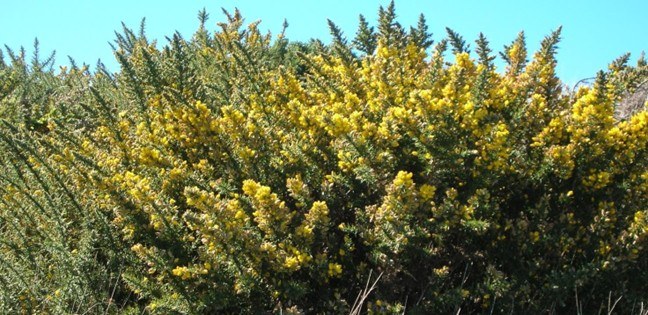
Gorse, also known as furze, is an upright spiny shrub that forms dense impenetrable thickets and can live up to 30 years. It usually grows to 2.5 m high but can grow up to 4 m or may grow wider rather than high. The root system is extensive and gorse is capable of producing roots from stems.
Young stems are green, hairy, ribbed and multi-branched ending in a long spine. Older stems are woody with light-brownish deeply-furrowed bark. Leaves on mature plants are narrow rigid 6-30mm long dark-green spines clustered along the branches. The leaves of seedlings differ and consist of three small leaflets (trifoliate).
Gorse flowers from around 18 months of age, usually in spring but it can also flower in autumn. Flowers are 15-25mm bright yellow and pea-like on a short stalk and have a distinctive coconut-like smell. Flowers cover the entirety of the shrub.
Seed capsules are hairy and pea-pod shaped 10-20mm long containing between two to six 3-4mm long hard coated seeds that can remain viable for up to 25 years in the soil.
Impacts
Gorse forms dense impenetrable thickets, displacing native vegetation altering the composition and structure of habitat, impacting on native animals.
Gorse infestations block passage along tracks, reduces the value of agricultural land, impacts forestry activities, and is highly flammable increasing bushfire risk and intensity. Fire tolerant, gorse plants regenerate from the base after fire, with seeds stimulated to mass germinate post fire producing a carpet of seedlings.
The dense prickly thickets provide harbour for pest animals including rats, rabbits and foxes. The spines can cause harm to animals, people and pets.
Distribution
Originating from Europe gorse was introduced into Australia as a hedge plant. In Green Adelaide gorse is mostly found in native bushland and in hills production areas and paddocks. It can also be found at disturbed sites, along roadsides, waterways and coastal environs.
Gorse requires an annual rainfall above 500 mm and tolerates variable soil types. Seeds fall mostly around the mother plant but in hot and dry conditions seed pods burst open and can eject seeds up to 5m. Seed are also spread by movement in water and contaminated soil. Birds and ants are also known to spread the seeds.
Management
Ulex europaeus (gorse) is a declared weed under the Landscape South Australia Act 2019 and is a Weed of National Significance.
The sale of gorse or contaminated goods; and its movement on a public road are prohibited. Land owners must take reasonable steps to control plants and prevent their spread.
We encourage control of plants where there is a risk to human health, agriculture, and biodiversity. Undertaking weed control needs to be done carefully to prevent damage to native vegetation.
A long-term integrated approach is recommended, utilising a mix of suitable control options. Programs need annual follow up monitoring and control.
Control methods
Hygiene
The best control measure is to prevent spread of gorse seed by implementing good hygiene practices. Clean contaminated soil from machinery before leaving infested areas.
Mechanical
Seedlings can be hand pulled when soil is moist with juvenile/small plants grubbed out with a mattock. In pastures, larger plants can be pulled with heavy machinery to remove the whole plant.
Large infestations benefit from ’grooming’ using heavy machinery to mulch plants down to their stumps, reducing plant mass and opening access to areas for further control.
Biological
For inaccessible locations or where there is a risk of damage to sensitive native vegetation biological control is an option. Gorse is not eradicated but the biological agents help to reduce plant vigour and seed set. There are several biocontrol agents in SA: gorse seed weevil Exapion ulicis, gorse spider mite Tetranychus lintearius, gorse thrip Sericothrips staphylinus and gorse soft shoot moth Agonopterix ulicetella. These biocontrol agents have varying success.
Burning
Hot fires will reduce plant biomass and destroy aerial seed but will also stimulate seed germination from the soil bank. Follow up control within a year is necessary before new plants can set seed. Landholders should be aware of local restrictions before using fire for control.
Grazing
Sheep and goats will only graze young plants and soft new growth on adult plants (before spines form). Grazing can be useful in an integrated control plan.
Chemical
Foliar spray when plants are actively growing ensuring complete coverage to achieve best results. For odd plants or plants situated in good native vegetation, cutting and swabbing stems is effective to avoid off-target damage.
For advice on chemical options go to PIRSA's Identifying declared weeds.
Observations of weeds can be entered into iNaturalist, an app which can assist with identification of species.
More information
Weeds of National Significance Weed Management Guide for gorse: gorse-weed-crc-guide-fact.pdf (environment.sa.gov.au)