Cobbler’s pegs is an environmental and agricultural weed that invades native vegetation and reduces crop productivity. The seeds stick to fur and clothing and are a nuisance to livestock and people.
Description
Cobbler’s pegs (Bidens pilosa) is an annual herbaceous plant that grows to 1m high. Its stems are square in cross sections and green to purplish in colour.
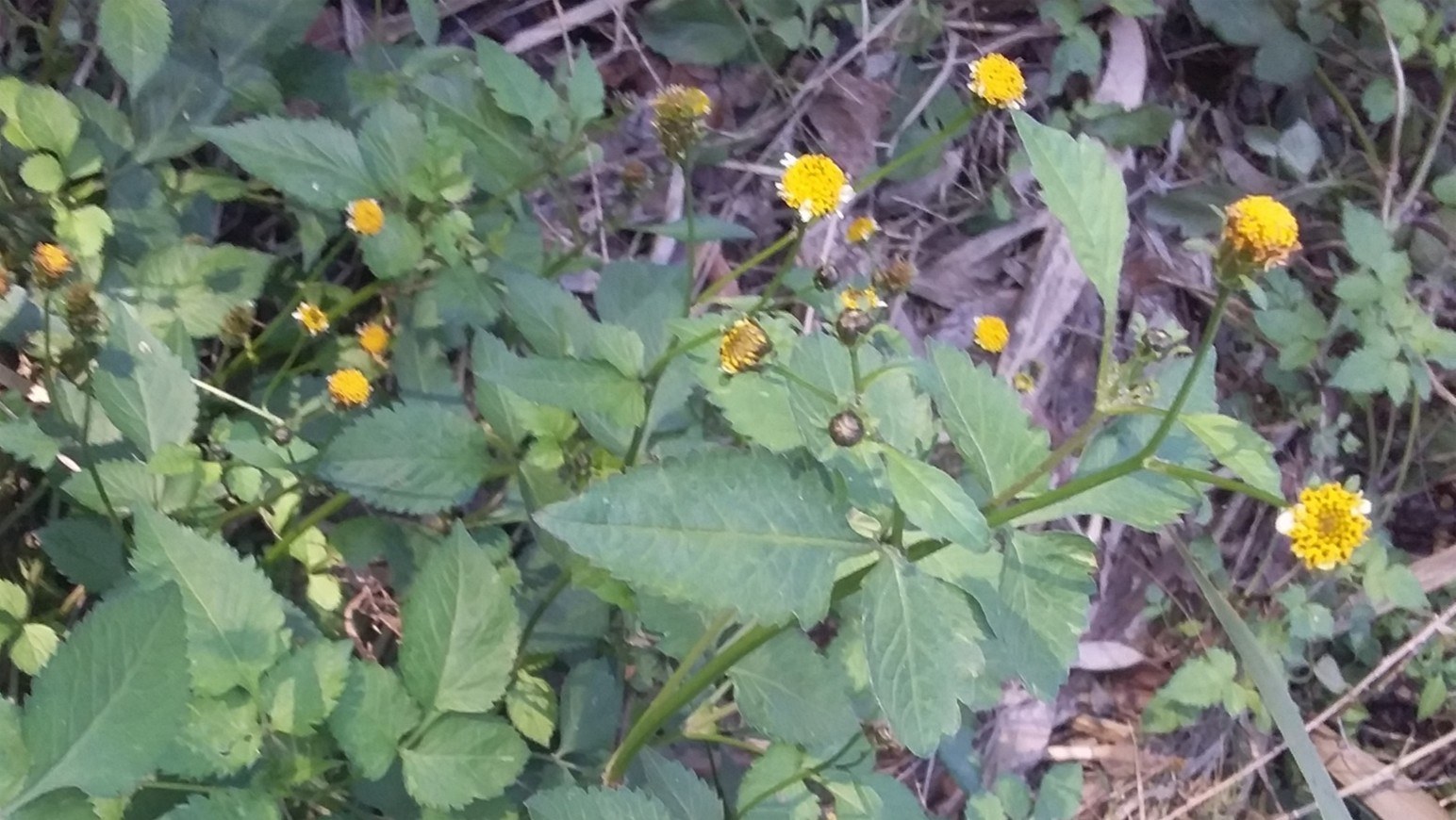
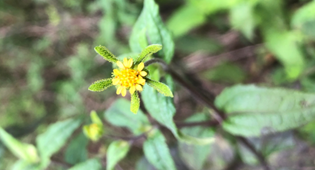
It germinates and flowers throughout the year in favorable conditions, but more commonly from spring to autumn. It has small, dense yellow flower heads are 5–15mm wide, with numerous linear, yellow tiny tubular flowers, 4–8mm long. The subspecies Bidens pilosa var. minor has flower-heads with white petals (ray florets), and the most common variety Bidens pilosa var. pilosa, has no petals.
The leaves are all arranged opposite each other, mostly 3–13cm long and 1–5cm wide, sometimes simple (undivided), but normally pinnate (feather like) and divided into 3–7 leaflets, with toothed margins.
The mature thin dark brown or black seeds are 4–15mm long, topped with two or sometimes three barbed awns (like little hooks) 1–4mm long that easily adhere to clothing and animal fur which helps with long-distance dispersal.
Similar species
Australian Sigesbeckia (Sigesbeckia australiensis ssp. australiensis) is similar to Cobblers pegs, but the petals on the flower heads are yellow. The seeds are slightly curved and do not have any awns.
Impacts
Cobbler’s pegs grows in a wide variety of habitats. It is a common weed of disturbed sites, such as waste land, vineyards, crops, pastures, parks, gardens and roadsides, but it also invades waterways, open woodlands and coastal sites.
Cobbler’s pegs produces a large amount of seed, which remains viable for several years. Seeds are easily spread attaching to people’s clothing and animal fur, on tyres, vehicles and machinery, floating on surface water and moving around with contaminated agricultural produce.
This weed can form dense populations that cover large areas where it will out-compete native plant species, prevent native plants from growing and reduce habitat for wildlife. It is particularly problematic in exposed margins of bushland and in revegetation sites.
The plant may reduce crop yield and can be a host to pests and diseases of agricultural produce, such as root knot nematode and tomato spotted wilt virus. The burrs may contaminate produce seed because they are difficult to separate out and they also degrade the wool of sheep and other livestock which produce fleece.
Burrs of cobblers pegs may be a nuisance to people when they attach to clothing and even on the hairs of human legs when brushing past the plants.
Distribution
There are only a few known locations of cobbler’s pegs in the Green Adelaide region. These are generally in association with watercourses and drains in urban areas.
Management
Cobbler’s pegs has a limited distribution in south Australia. By controlling this plant early and reducing its extent it may be possible to greatly reduce the impacts of this weed in South Australia.
We encourage control of cobbler’s pegs to help reduce impacts on public amenity, agriculture, and biodiversity. Undertaking weed control needs to be done carefully to prevent damage to native vegetation.
Control methods
The best approach is hand pulling plants before seed set in late summer to autumn. If plants have seeds, these must be carefully removed as seeds can easily fall and spread.
Hygiene
Ensure vehicles, machinery and clothing are free from cobbler’s pegs burrs before moving to other areas.
Manual
Hand removal is a very effective way to manage cobbler’s pegs. While this is best done before the plant sets seed in late summer to autumn, often plants aren’t noticed until after flowers and seeds are present. In this case, care must be taken to ensure all seeds are removed. Seeds don’t readily hook onto skin so you can use your bare hands to remove and bag any seeds that are present.
Cobbler’s pegs has a strong central root (called a tap root) and produces roots along its stem where it comes in contact with the soil. Remove as much root material as possible to prevent reshooting. Plants that are removed should not be placed on the ground as they can re-root into the soil. Instead, they should be bagged and taken off site.
Any plants with flowers or seed heads should be double bagged and placed in the general waste bin.
Chemical
Herbicide control can be effective if applied prior to seed set. Care must be taken to avoid off target damage to native vegetation. Always follow the chemical label directions and take required personal safety precautions.
For advice on chemical options go to PIRSA's Identifying declared weeds.
Observations of weeds can be entered into iNaturalist, an app which can assist with identification of species.