Boneseed is a woody perennial (long lived) shrub that can reproduce rapidly to displace native vegetation of coastal dunes and inland bushland affecting native animals and birds.
Description
Boneseed (Chrysanthemoides monilifera subsp. monilifera) is an up-standing shrub with woody branched stems growing to 2 m tall and has a shallow root system. Boneseed is a fast growing plant with a lifespan of up to 20 years. Leaves are bright green, thick and waxy with serrated edges and a vertical centred vein, narrow at the top and bottom but broad across the middle. New growth is typically covered by white downy cotton-like hairs.
Flowering occurs from August to October and plants are usually at least 18 months to three years old before they flower.

The yellow daisy flower heads form in groups of 3 to 12 flowers, with an individual flower having 5 to 8 bright yellow petals formed round the edge of a deeper yellow centre.
Fruit resembles a round fleshy berry which are green when young and turn black when mature. The fruits contain a single, smooth, round seed which is bone-coloured when dry, hence ‘boneseed’.
Mature plants produce up to 50,000 seeds per plant and the soil seed bank can contain 800 to 2,500 seeds per square metre. Seed is the only form of reproduction and germinates mostly in autumn but in favourable conditions can germinate any time. Seed can remain viable in the soil for at least 10 years, especially if buried deeply. Fire stimulates germination.
Similar species
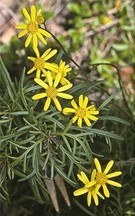
Common coast groundsel (Senecio pinnatifolius) is an Australian native herb that grows up to 1 metre in height, with daisy like yellow flowers. A few plants have been found in the Adelaide area along the Mount Lofty Ranges.
There are differences however in the leaf shape. Common coast groundsel has deeply divided leaves compared to the whole leaves of boneseed.
Impacts
Boneseed is highly invasive, taking over bushland and coastal dunes eliminating native vegetation, changing the structure of a vegetation community and preventing any regeneration. This affects the native animals and birds that rely on natural habitats for food and shelter.
It is invasive due to its rapid rate of growth, large seed store in the soil and ability to regenerate after fire. Boneseed also has a greater effective leaf area and more vigorous root system than many native species, giving it a competitive advantage. Boneseed may also have allelopathic (chemical) properties that prevent some plants from growing near it.
Distribution
Boneseed was introduced as an ornamental garden plant from South Africa, and is now a significant weed of native bushland along the coast and in the ranges of the Green Adelaide region.
Boneseed is adapted to a winter rainfall temperate climate, and grows on many soil types but prefers sandy soils and disturbed sites. It tolerates salty conditions but not waterlogging or prolonged drought.
Boneseed is spread by the dispersal of seed. Birds that eat the seed are the main cause of spread. Rabbits and foxes also eat the fruit and spread the seeds in their droppings. Movement of contaminated soil and seed in waterways can also help spread the weed.
Management
Boneseed (Chrysanthemoides monilifera ssp. monilifera) is a declared weed under the Landscape South Australia Act 2019 and a Weed of National Significance.
To prevent the spread in the Green Adelaide region, the sale of this plant or contaminated goods is prohibited and the movement of either on a public road is restricted. Land owners must take reasonable steps to control plants on their property.
We encourage control of plants where there is a risk to human health, agriculture, and biodiversity. Undertaking weed control needs to be done carefully to prevent damage to native vegetation.
Control methods
Hygiene
To prevent the spread of boneseed, thoroughly clean soil from shoes and equipment before leaving an infested area. Do not move contaminated soil.
Mechanical
Hand pulling or digging out of plants is most effective for small isolated populations and in sensitive areas of native vegetation. Ensure the dominant taproot is removed. This is best done when the soil is moist and before seed set.
Soil disturbance should be minimised to avoid stimulating germination of seeds that are left in the soil. Monitor sites frequently for several years and destroy any new seedlings before seed development.
Chemical
In degraded sites, targeted spot spraying plants while they are actively growing is effective.
To avoid off target damage in conservation areas and bushland, it is best to cut stems and swab stumps with herbicide, using a sponge applicator.
For advice on chemical options go to PIRSA's Identifying declared weeds.
Observations of weeds can be entered into iNaturalist, an app which can assist with identification of species.