Bathurst burr is a summer active annual herb with sharp spines that infests bare ground. Horticulture and agriculture industry are impacted with the prickly burrs contaminating wool and the sharp spines harming people and animals.
Description
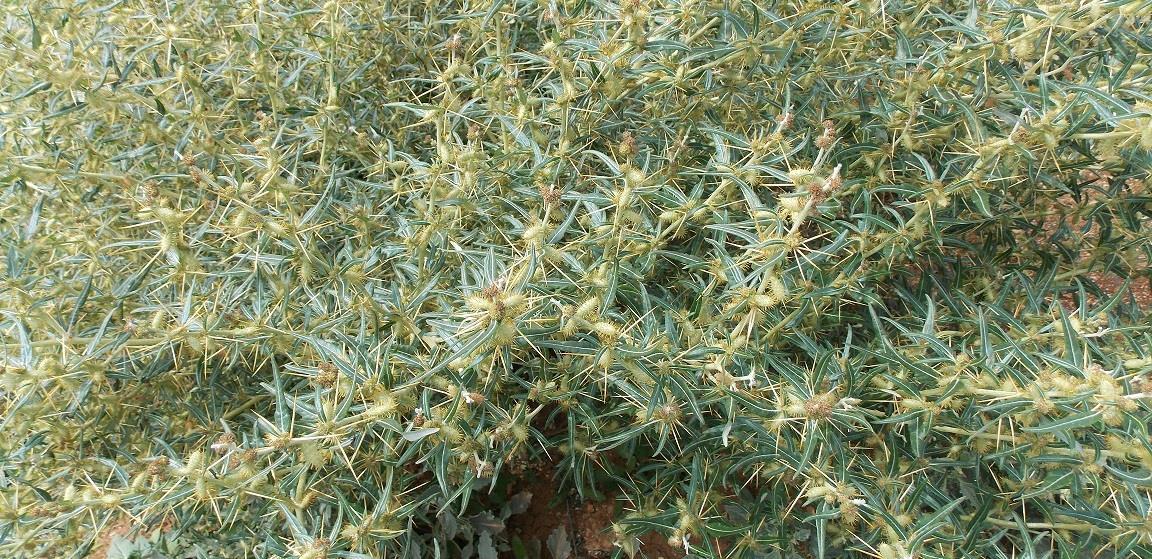
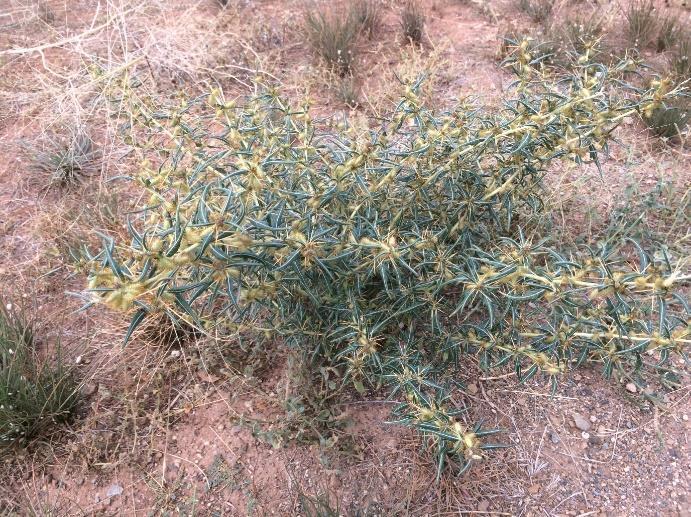
Bathurst burr, also known as burrweed, sheep’s burr or cockleburr is a short-lived, multi-branched, erect spiny herb growing 30 to 100 cm high with greenish-yellow hairy stems. Plants germinate in late spring following rain and die in early winter retaining their form.
Upper surface of leaves is dark green and shiny with prominent whitish-coloured veins but the underside of the leaves is pale green and covered in fine hairs. Lower leaves are irregular in shape (3 lobed) but the upper leaves are elongated. At the base of each leaf stalk are yellow or greenish-white 3-pronged spines up to 2.5 cm long.
Plants flower throughout the year, but mostly in summer to early autumn with both male and female flowers occurring on the one plant. Male flowers are yellowish or creamy-white forming dense rounded clusters toward the tip of the stem whereas the inconspicuous greenish-coloured female flowers are single or in small clusters situated where the leaf meets the stem.
Seed capsules form usually in late summer and autumn where the female flowers occur. The capsule is covered with slender yellow hooked spines (so-called burrs) and contain two seeds. Bathurst burr reproduces only by seed. The seed can remain dormant in the soil for at least three years and require a year with summer rains to provide adequate water to break seed dormancy.
Impacts
Bathurst burr impacts on pastures and grazing establishing best in trampled or overgrazed areas. The burrs contaminate fleeces, irritating the hands of shearers and they can break the combs of shearing machines.
Bathurst burr can also infest irrigated horticultural crops where the burrs are a nuisance to pickers.
Distribution
Bathurst burr is native to South America. It has been found scattered across the Green Adelaide region. Common infestation areas include stockyards, camps, and overflow areas around troughs. It infests bare disturbed sites, waste areas, roadsides, pastures, but mainly moist areas including irrigated crops, floodplains and waterways. Bathurst burr spreads via burrs attaching to the fur and wool of animals, clothing, vehicles and machinery. Burrs and seed are also spread by water movement and in contaminated soil and produce.
Management
Bathurst Burr (Xanthium spinosum) is a declared weed under the Landscape South Australia Act 2019. To prevent the spread in the Adelaide area, the sale of this plant or contaminated goods is prohibited and the movement of either on a public road is restricted. Land owners must take reasonable steps to control plants on their property.
We encourage control of plants where there is a risk to human health, agriculture, and biodiversity. Undertaking weed control needs to be done carefully to prevent damage to native vegetation.
Control methods
Hygiene
The best control measure of Bathurst burr is to prevent spread. Implement good hygiene practices for the movement of stock, produce and machinery from infested areas. Remove burrs from clothing before leaving infested sites.
Ecological
Bathurst burr is a poor competitor with established dense pasture or vegetation. Maintaining good pasture or vegetative cover is effective in suppressing Bathurst burr. Avoid over grazing pastures.
Mechanical
Grubbing or digging out of plants is effective for small isolated populations and in sensitive areas of native vegetation or water courses. Removed plants can be stacked for burning on site (check your council for burning regulations) or disposed of in a household waste bin. Soil disturbance should be minimised to avoid stimulating germination of any Bathurst burr seeds that may be left in the soil. Monitor sites and destroy any new plants before seed development.
Chemical
Bathurst Burr is highly visible when growing and control in pasture is readily achieved with use of herbicides (weed killers). Avoid spraying non target plants.
For advice on chemical options go to PIRSA's Identifying declared weeds.
Observations of weeds can be entered into iNaturalist, an app which can assist with identification of species.